Thursday, 19 September 2013

Melkam Addis Alem


Billboard hits from 2006

-       Don’t Forget About Us- Mariah Carey
-       Check on It – Beyonce
-       You’re Beautiful – James Blunt
-       Temperature – Sean Paul
-       SOS – Rihanna
-       Hips Don’t Lie – Shakira
-       SexyBack – Justin Timberlake


While 2006 seems well in the past to many in Ethiopia, this time last week (our Sept 11) Ethiopians were ringing in their new year! Happy 2006—take two?

 The Ethiopian Calendar is based on the Alexandrian or Coptic calendar, this puts them seven years behind the majority of the world who follow the Gregorian Calendar. The amount of days between the two calendars fluctuates as they also have a 13th month known as Pagume and all other months only have 30 days (minus leap years).

Ethiopians also use a different clock, which can create confusion when making arrangements with the likes of taxi drivers or restaurants. What the international community would refer to as 8pm or 20:00, in Ethiopian is 2 o’clock (6 hours behind a standard 12 hour clock). The easiest way people tend to differentiate is by referring to one as Habesha (Ethiopian) time and Forenji (foreigner) time.

So how do Ethiopians celebrate the New Year?

While at home there is always a lot of hype around making great NYE plans, it tends to be one of those nights that most find to be overrated. And yes there were many events, concerts, dinners etc. that you could attend in the city similar to the type you would attend in Canada. Yet, hands down the most common response I received when asking Ethiopians what they would do to celebrate was “eat meat.. lots and lots of meat”. Thus in order for the Ethiopians to eat all this meat goats, cattle chickens etc had to be slaughtered on the masses. Needless to say there was a noticeable increase in livestock roaming the streets of Addis, likely on route to the slaughterhouses, in the week leading up to New Years.

It is however worthwhile mentioning that this year Sept 11th fell on a FASTING DAY. Now what might that mean? All Orthodox Christians (the majority of Ethiopians) ‘fast’ every Wednesday and Friday which essentially means they are vegans for the day- aka they consume no animal products. Thus, this put a huge damper on the main event- meat eating- of the celebrations! As a result many also took Thursday as a holiday, slaughter their goat or chickens, and made up for the lost day by consuming more meat than most can imagine!

It was wonderful to be here for New Years, the atmosphere in my office alone on NYE day reminded me of grad school children, unable to focus before their Christmas holidays! There was a coffee ceremony, cake and lots of Ethiopian dancing! As excited as I am, to re-live 2006, I am even more excited that many consider the Ethiopian New Year to mark the end of the rainy season! Bring on the sunshine!

So happy 2006 every body! Melkam Addis Alem J

Friday, 6 September 2013

Sports


X-Rugby Team Post National Championship Win


As the rain is finally drying up in Addis Ababa, I know that the leaves are slowly changing colours and the humidity fading in the little town of Antigonish Nova Scotia,which more importantly means that the university rugby season is starting. While I have naturally missed many things during my three months in Ethiopia –family, friends, summer weather, THE OCEAN, organized infrastructure…etc- Now that it is fall in Nova Scotia, I wish I could be playing with my X-rugby family as they kick off against Acadia tonight to open their season.

For as long as I can remember, I have been part of a team whether soccer (football) or rugby. As it was my ‘normal’ I did not realize the massive impact it has had on me as a person. Yet as this is the first time in FIVE years I am not playing X-Rugby, I find myself feeling as if I am almost missing something. When at the gym, I used to run faster or work harder primarily to secure/ fight for playing time. I remember the first time I went for a run once our season finished last year, I couldn’t help but ask myself what my purpose was? Is this simple for my physical fitness? A foreign concept to me!

So what is it that drew me to spend sooo much time with a team? Why do people pay big bucks to sit at professional games? Playing rugby at StFX was an incredible experience, for so many reason, but the only way I can explain it was when you were on the field, and everyone was on their game, it felt like you were one piece of an incredible well oiled machine, you knew that you were never alone, for me it epitomized teamwork and accomplishing something as a group that would be far out of your reach as an individual. When people would ask me how I spend upwards of 15 hours a week practicing and playing a sport, I would ask ‘how could I not?’ But up until recently, now that it isn’t at the center of my world, I could never have explained what pulled me to be part of it, it was just never a question in my mind. In hindsight however I think it is that feeling of being part of something bigger than you alone.

While I can hardly speak for all of society I think that there is something very powerful about sports, something unifying, something larger than ourselves whether you are actively participating in the game or engaged as a spectator. I know I chased that feeling for years, and the natural high I gained by playing rugby and winning two national championships with my X-Rugby family is a natural high I can compare to nothing else I have ever experienced.

Yet I also see this passion translated to fans. While at home in Canada it may be a passion for hockey which is most popular, but in Ethiopia my short time here has lead me to believe the passionate support is strongest for their national football team and runners. The first of my two experiences with this pride was when a parade erupted on one of the main roads when Ethiopia beat South Africa in a world cup-qualifying match, EVERYONE was cheering and dancing sporting the team’s colors. Or when their runner (Tiru) took the 10 000m title in Moscow- I was in a small bar in Yabello (500+km south of Addis—the middle of no where!) and 35-40 people were huddled around a small TV stand set up outside. When she won the small crowd erupted in cheers, hugging and congratulating one another for their nations victory.
Pre-Match vs South Africa - Fans on route to watch at Meskel Square
photo credit to Caroline


There is a wonderful unifying and connective power to such moments of celebration. A city or groups of people feel alive. It is for this reason that I am likely going to stake out a local sports bar this weekend with whoever else is game, to secure a good seat for when the Ethiopia – Central Africa football match starts.

So, to my X-Rugby ladies, even though I am half a world away TOP LEFT, I am still and will forever be with you even if not physically present. Best of luck defending your national title this year! And if my internet cooperates you best believe I will be watching all of the live streamed games… even if they do come in more like a slideshow of photos!

Monday, 2 September 2013

A Right of Passage


For most of August a group of us, made up of Oxfam and Coady staff, traveled to three project areas in Southern Ethiopia to collect information as part of a final evaluation. It was an exciting opportunity for me to sit with many of the project participants and hear their stories, opposed to sifting through jargon heavy documents in an office! I really appreciated the way the evaluation was conducted as well- we used a Most Significant Change Approach (MSC), MSC is an evaluation technique which allows community participants to tell stories about changes in their lives since the project started—and then they rate the stories in terms of which changes were the most important. These are then compared to a baseline that was set at the beginning of the project.

Examples of unexpected change continued to present themselves, but the most intriguing by far was outside of Yabello, where one community brought a training they received on household expenditures (the Leaky Bucket) to their traditional authorities. The result was such that, once the traditional authorities realized how much money was being spent on Alcohol and Chat(a local leaf which is chewed to become high) they decided to enforce somewhat of a prohibition in the area…

On Day 8 of our travels, our group was set to visit a Gum and Incense collecting cooperative, approximately 40km outside of Yabello. While the distance of 40km may have initially seemed like a trivial detail, it later proved to have quite the impact. The first 20km of our journey that morning was on typical Ethiopian road, aka hardly an American interstate but MORE than sufficient. As for the second 20km, well if you spun me around in the middle and asked which way the road went I would have laughed and said ‘what road’? Needless to say the combination of my third row seat and my tendency to become car sick did not bode well. A Kenyan colleague joked that I should feel lucky to be receiving a free “African Massage” and laughter immediately erupted throughout the car!

When arriving at our destination, I felt as if I had just gotten off of a ride a universal studios and my stomach was in my throat. As my colleagues could see this based on the color… or lack there of in my face they insisted I stay in the car for a moment to regain myself. Feeling like a silly forengi—foreigner—I fought my better judgment and after 10 minutes I returned to the group. Immediately upon sitting down I knew this was no longer just carsickness. I made my best efforts to discretely remove myself from the focus group discussion and rejoin the drivers reclined in their cars. Just when I thought I felt better I realized my bean breakfast was about to made a re-appearance. A Camel watched me throw up, next to a piece of used cardboard that upon a second glance I realized read “WFP” (United Nations World Food Program)—I couldn’t help but ask myself "Where am I write now?!" It was certainly a situation I never could have imagined this time last year.  

I have since realized that I likely had food poison, as later that day I could no longer retain fluids. (I am incredibly thankful for CIPRO! Never ever ever ever travel without it!) Now that I have recovered, my experience of getting sick has come to feel very much like a right of passage. I feel as if I could ask almost anyone in Addis what their worst “sick” story was, and if they didn’t have one they would certainly be incredibly thankful and somewhat surprised by their good fortune.  

Beyond my realization that my water throwing up experience 500+km from the capital, was nothing short of a right of passage it also made me aware of a number of other things, particularly how fortunate I am in soooooooo many ways.

Firstly, that I was traveling with amazing colleagues who wanted to make sure that I was fine and treated me like family. I felt like my hotel room window was a reverse drive-through and people just kept bringing things to my window, in hopes that it would make me feel better; crackers, juices, flat pop, whatever they thought might help.

Secondly, while I am aware that people who live in rural areas have a much better tolerance for the local foods due to years of building up the right bacteria, when they become very ill, a large portion would not have access to the luxuries I had at my disposal—a Toyota Land Cruiser and driver to take me back to Addis—(he was already taking someone else!).  The experience also made the rural quality of health care more apparent. There were many health centers present but they often lack the physical materials necessary as well as the staff. Some colleagues explained that while Ethiopia has at least two reputable medical training facilities, many trained professions seek work outside of the country, tempted by much better wages. 

However, in stark contrast to the quality of healthcare available in rural areas, my experience at the Korean Hospital (one of many hospitals in Addis) made me aware of how efficient the medical system is in the capital. I was in and out of the hospital in less than an hour and half, having seen the physician twice, once before and after additional test. I was blown away at the speed and quality of service—perhaps based on the fact that I have spent many long hours in Canadian Emergency rooms!

All and all I took my health and my privilege in being able to maintain it seriously for granted until I was ALMOST not even COMPLETELY in a situation where I was not immediately able to access some of those privileges.


Steph xx
As always feel free to get in touch at steph.milo.mackinnon@gmail.com 

Tuesday, 6 August 2013

What is Home?


 Where are you from? Where do you live? Where is Home?

At first the answer may seem to be the same to all questions, and it very well might be for some people. BUT if you are like me and hopelessly continue to seek new adventures, the answer can be a little more confusing that immediately meets the eye.

I vividly remember in my first year of university, when I was a resident of MacIsaac hall—Go MAC GO—The first time I referred to it as “home”; I was sitting in the dinning hall and said I had to go “home” and get something, and then it hit me, what is home now? Is it my 10 square foot room, which I share with my new best friend? Or is it where my parents live in New Brunswick? Now that my parents have moved from New Brunswick to Halifax it complicates this question even more and I tend to flop back and for with what I define as “home” or default to “the Maritimes”.

But this is either here nor there, the point I am looking to get to at are the steps which lead us to feel like a new space is “home”. The one big thing I find is that it is a feeling of relief in the pit of your stomach after traveling somewhere else and returning to the comfort of your new “home”. Each place I have lived for any extended period of time has had a landmark that somehow manages to subtlety scream to your insides that you are ALMOST BACK to a comfortable place where you can completely relax. In New Brunswick, it was in Hampton, or the turn where on a clear day you could see the ‘deephole’ swimming spot. While living in Antigonish it was the red barn at barneys river, in Lille it was the annoying sound that the trains would make to let you know you had arrived at Gare Lille Flandres, In Ghana it was the Market where you would turn off the main highway to go towards Ada, typically stopping at a Gas station where Kofi would fill the tank of his Subaru... And here in Addis, in its own weird way it’s the traffic, but more specifically the grain silo’s close at the junction by the entrance to the city. The first time this happens in a new “home” it always takes me by surprise, quite pleasantly though I might add.

This sense of “home” I have found usually come at the same time as things start to have a proper “place”, you know where you put your keys, or if the measuring cups aren’t in the ‘right’ drawer. I personally feel like the moments when you realize you have made a new place a home, is one of the most satisfying about traveling and living abroad. You realize that no matter the circumstance you can “make it work”. I also think it speaks volumes of the people who you are living with and the locals. Because they can either speed up or slow down the process, if they are helpful or a pain.

For lack of a better explanation it’s having established ways of navigating daily life or a routine. So why am I writing this now? Because after being in Yabello for one week I felt that sense of comfort driving back into the chaotic streets of Addis Ababa. And then again, when showing Adam (our coordinator from the Coady) around Addis, I was once again reminded that this crazy city, which in my first few weeks left my head spinning, had in fact become my home.  

I honestly feel that one of the greatest things about going away is not only that you are able to experience new things, but that you are able to appreciate the people who are rocks in your life so much more when you're away from them.

I am set to travel to Southern Ethiopia (likely without internet) until the 23rd of August; not only am I looking forward to the amazing experience that I anticipate in and of itself, but I am also excited to return to what I now know as my “home” in Addis Ababa.

Sending all my love from Addis,
Steph x

And as always, even if I may not be able to respond for a while, please feel free to get in touch via my e-mail: steph.milo.mackinnon@gmail.com

Tuesday, 23 July 2013

Hakuna Matata


 Yabello in the distance
Red Soil that reminds me of PEI
minus the SUPER dry factor...
As a child, the lion king was one of my all-time favorite movies—perhaps not to the same extend of one of my good friend’s whose parents recount how she watched it on repeat waiting for her older sister to return home when she first started school!—nonetheless I knew every word to every song and always dreaded the scene when Mufasa was  trampled to death! As a child I saw the ‘Lion Kingdom’ as a far off, distant, or imagined land. Last week myself and four coworkers made the TWELVE hour journey to Yabello in Southern Ethiopia( Aprx 200km from Kenya). I had never been to a similar area, with Acacia trees and termite towers, sparsely dispersed across the arid plains of red soil, cratered along the edges of the road as evidence of the rainy season which ended a month early, and the mountains in the distance. Yet, on the way to visit a community project just outside of the main town, there was one particular turn we took, where the narrow road hugged the corner of a mountain which overlooked the entire valley bellow and as CHEESY as it sounds I was brought back to my childhood and instantly thought of the famous scene where Mufasa sat looking over the rich land beyond him and Simba and said ‘Everywhere the light touches, this is our kingdom’. It was one of those moments where you have to ask yourself “Is this real life”? Or who am I to be so fortunate to experience such variety in life? This particular day I was tasked with interviewing two members of a Gum and Incense cooperative group. I was thrilled to be able to finally put a human face and personal stories to the program reports I had been reviewing in the office.

A termite creation...
Interviewing someone—asking open ended questions and trying to make someone feel comfortable enough to share the details of their reality— in ones native tongue is a challenge in and of itself, working with a translator added an extra layer of interesting to the process! But as the morning drew on, I gradually became more comfortable with the process and am hopeful that the case stories I will write from the material gained will to justice and adequately represent the work and learning’s of those I interviewed!

One of the coop-women asked if we
could take a picture! 
Working with the translator was hardly my only encounter with language immersion. While I am doing my best to pick up the basics of Amharic (and can now hear many familiar words if I listen closely enough to conversations around me!) I would be lying if I didn’t say that I had NO IDEA what the plan was 85% of the time we were away. All of the co-workers I was with were Ethiopian and while they would do their best to include me in conversation, I found that people naturally return to their native language, especially when tired.  My friend and I joke that experiences such as having no idea why the car is pulling over, or finding out that the reason you never received a menu at lunch was because you have been ordered a traditional meal already, will only serve to make us the most easy going people possible! While I still haven’t be able to let go completely of trying to figure out what’s happening, I try to limit the amount of questions I ask knowing that my coworkers have thus far only had my best interest in mind. I am also hopeful that if I keep practicing my Amharic, by the end of my stay I will know without having to ask that when we randomly pull over on the side of the highway its because someone wants to buy strawberries!

On another note, Yabello also extended my questioning of the relationship between Ethiopians and outsiders/ International organizations… what role do we play? The Borena Zone of Southern Ethiopia, where Yabello is located, is highly drought prone and as a result is one of the areas with a high density of AID organizations and NGOs. To paint the picture a little more, on the 7km drive from the main highway to the town center there are field offices for; UNFAO, World Vision, Save the Children, USAID and a few other less known organizations.

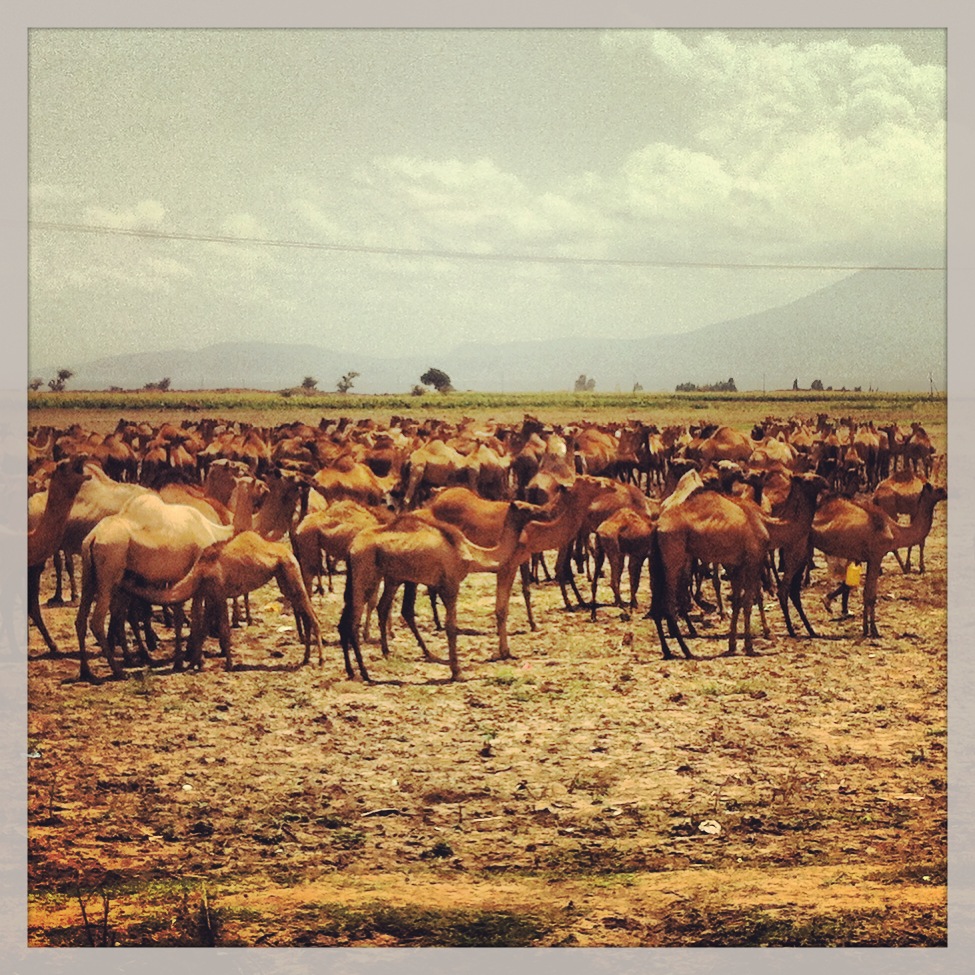
What is a group of camels
called? A herd?
The image which resonates in my mind and really hammered home this whole idea of a clash of worlds for me was a local man walking down the side of the road with his two camels who were carrying a   What were the stipulations? As always many, many questions and very few answers was what I was left with. Needless to say I wont soon forget those two camels.
load (bear in mind that while on its own this is a new visual for me! it is typical of the area) but furthermore upon closer examination I noticed that the packs the camels were carrying were labeled USAID. A flurry of questions instantly flew threw my mind; how long has this man been receiving AID? What was in the pack? Would be starve without the assistance? Was it creating dependence?

Much love,
Steph x

As always if you have any comments or questions please feel free to e-mail me at: 
steph.milo.mackinnon@gmail.com


Just a couple of pictures of the Amaro Mountainside on route to Yabello (aprx 150-200km closer to Addis) and some donkeys...


Thursday, 11 July 2013

Cultural Crossroads


One of the benefits of being in Ethiopia is that it is very much situated at a cross-roads; not only in terms of some of the worlds great religions, but also culturally. Baring influences from North and East Africa as well as the Middle East. This religious diversity shows its face in the countries many rich historical sites from Lalibella- which boast a collection of famous  12th/13th Century monolithic rock-cut churches (http://en.wikipedia.org/wiki/Lalibela), to Axum, which is where many believe the Holy Grail is housed (http://whc.unesco.org/en/list/15)  and Harar in  the East is acclaimed as the Fourth holiest city for Muslims after Mecca/Medina/Jerusalem.

So what does all of this diversity mean for me on a daily basis, as I am living in Addis not amongst the churches or historical walled cities? Honestly it means a lot of things, but on a simple level it means A LOT of different types of food readily available! Yes I have finally decided to write about food!
Earlier this week, I went out for an awesome Lebanese meal with some other intern friends. It turns out that another man living in our compound is actually a Lebanese man who works/sings at the Restaurant, he invited out German friends to the Restaurant on Monday and so the event was set. Naturally we then invited our friend Yasmine, who is also a CIDA intern but grew up in Beirut. Her presence at dinner was a MASSIVE asset! When she first spoke Arabic to the restaurant manager his face light up and they both immediately started speaking a million miles a minute, hands enthusiastically moving at the same pace… if you thought Italians spoke with their hands a lot, you obviously haven’t encountered an excited Lebanese exchange!

The rest of us sat and watched the exchange without a clue of what was being discussed… something we have all grown used to living/working in a foreign city. We had faith in Yasmine though, as she had given us a mouth-watering description of every item on the menu, with details of how it’s prepartion/presentation differs from region to region. Eventually the excited manager left and Yasmine caught us up! A ton of appetizers, Mezzas, were ordered and soon after came with enough pita bread to sink a ship. We also learned that you are to separate the sides of the bread and use them to eat the different delicious apps; which ranged from Tabouleh, to a bean dish, hummus, babaganoush and many others. I also learned that LEMON is beyond key, and an absence of olives is almost insulting!

The experience overall was fantastic, it was quite possibly the most delicious meal, with the most diverse amount of flavors I have had since being in Addis. I also feel very fortunate to have found a friend in Yasmine as she is very eager to tell stories of Lebanon and its culture and I am eager to learn. My grandfather’s parents emigrated from Northern Lebanon and while I have very fond childhood memories of huge family gatherings with obnoxious amounts of food, I feel that as the family has aged I have very much lost touch with my Lebanese roots! Who would have known I would reconnect with them while in Addis?

Lebanese food is however only one of the many options available here in Addis. Within walking distance from my office/home there is German, French, Armenian, and TONS of Italian food available. I never ever thought I would say it but I may actually be tired of Pasta and Pizza by the time I leave! But lets be honest, the best pizza I have had thus far, is conveniently served in the building directly beside my office! 

And yes ETHIOPIAN food. I have been saving the best for last! It is its own unique can of worms. First I think it is necessary to describe the staple food; injera. It looks like a biiiiiig pancake, kind of? But in reality it is a thin, often incredibly yeasty bread. It is served on a big silver platter, where you unroll it and pour different sauces (wot’s) on top. The best part, and the most difficult at first, is that you eat it WITH YOUR HANDS, you pull off pieces of injera  and dip it in the sauce/pick up pieces of meat or veggies. Ethiopians, who have been eating injera their entire lives make this practice look effortless. It is definitely not as easy as it looks, especially as it is considered rude if your left hand touches your food! 

Another interesting aspect of Ethiopian dinning culture is the many, many fasting days (Both Orthodox and Muslim). At first I thought this meant NO eating. But the reality is that it means no animal products… aka vegan. There are long fasting periods, which last for weeks, but every Wednesday and Friday are also fasting days. This has proven to make life easy when choosing to dine out Ethiopian style, as it is much easier to say you are fasting in a foreign language than explain why you just do not want to eat meat for fear it may upset your stomach -definitely less culturally offensive! And the fasting dish, Fasting Bianatu, is amazing! You get a big tray of Injera with six different Vegan sauces to dip into; two lentil variations, pickled beets, potatoes and spinach amongst other things. All Ethiopians feel the need to warn the foreigners that the food will be “spicy” and yes they like to throw in the odd hot pepper, but as foreigners we have to be careful that they don’t just eliminate the peppers for fear it will be too hot for us!

Now the Coffee, an Ethiopian meal would not be complete without a proper coffee ceremony to cap it all off. When I first heard coffee ceremony, yes I expected elaborate dancing and singing centered around coffee… but I was way off. Nonetheless it is still great, the coffee beans are roasted and ground down on the spot and then warmed in a traditional clay pot. When it is ready to be served a women, often traditionally dressed will bring the clay pot, with incents and popcorn to your table, carefully pouring coffee into each espresso sized cups.

Each region boasts its coffee’s superiority. I have realized that not only is the coffee substantially stronger here BUT also that there are many different types of coffee, much like I only understand the basics of Wine, my palate is unable to note the discrete differences between the different types of coffee. However, I do enjoy my morning Macchiato which sets me back aprx. 50c Canadian. It took me about a week to realize why the Macchiato my co-workers would order for me were substantially better than ones I ordered myself. Much like the spicy issue, I realized that the servers’ assumed I wanted more milk than coffee. I have since learned the Amharic word for “black” Macchiato, ‘Tocar’ and needless to say it has made my Macchiato experience consistently more enjoyable, and often allows the server an opportunity to laugh at my pitiful attempt to pronounce the word!

Much love,
Steph x

As always if you have any comments or questions please feel free to send me an e-mail at: steph.milo.mackinnon@gmail.com 
Thanks again to all who have:) 

Thursday, 4 July 2013

Mountains Beyond Mountains - A taste of Southern Ethiopia


I would never describe myself as an art enthusiast, yet when traveling I tend to migrate to the classic ‘must see’ museums. And while I would be lying if I said I understood even a fraction of the art I’ve seen, I have appreciated it. One of the particular exhibits that continues to stand out in my memory was that of Salvador Dali’s in Montmartre, Paris. It was a simple, modest set up located amidst narrow winding streets, coffee shops, colorful graffiti walls and overgrown ivy. Well the character of the neighborhood distinguished the experience in and of itself if was my understanding of Dali’s notion of time that stuck with me the most. His famous melting clock appears in many of his famous pieces but it first appeared in his piece titled ‘The Persistence of Memory’.

'The Persistence of Memory'
The caption under the sculpture reads:

 As the watch liquefies over the tree, it forms into a human profile, underlying the interminable relationship between man and time. The unexpected softness of the watch also represents the psychological aspect whereby time, whilst considered to be precise and fixed in its nature, can, in fact vary significantly in human perception. All men must bend to the passing of time.


My third row oasis 
So where does Dali fit into my experience in Ethiopia? Well last week myself and four other Oxfam staff made the 450km journey to Amaro for the inauguration of a 'Bulla'* Processing Center. As we drove the winding road through the lush green mountainous Ethiopian countryside I became lost in my thoughts while lounging in my third row set up. On June 1st I boarded the plan in Halifax, while I was filled with nerves and excitement for the journey that lay ahead, I also had to take many deep breaths and try to convince myself that six months wasn't the eternity it felt like in that moment. Sitting in the third row of Oxfam's SUV I found it hard to fathom that an entire month of my stay had already flown by! Ethiopia has quickly come to feel like my home and December often feels like it is just around the corner. Thus rather than wondering how I will make it until then, I find myself asking if I will be able to see and do all the things I'd like to in such a 'SHORT amount of time'.

Around Dilla on route to Amaro

While Dali's notion of time lingered in my thoughts, curious as how it was possible that this shift in my perception of time had occurred, other ideas from my past also flowed through my wondering mind. I firmly believe our experiences shape the way we view the world and I feel incredible fortunate to continue to have experiences, which challenge my perspective of the world. My question however is, what makes certain memories or moments stick? Or in other words become part of our framework shaping the way we view the world, while others pass us by never to be considered again.

Camels hanging out.. 
While I feel more than incapable of answering this question I couldn’t help but feel that as we continued to wind down the road –passing all sorts of new visuals for me, from camels stopping for a snack, to young men playing ping-pong with there donkey impassively watching beside them—my thoughts instantly went to a childhood road trip game when I saw a white horse. As kids our parents always told my brother and I that if you saw a white horse it was good luck to keep your fingers crossed until you saw a dog. My brother and I would silently peer out the window as the minutes of the journey passed by. Years later, to our disappointment, we found out it was one of our parents creative tricks to keep us quite/ calm us down on long drives, one if I may say so myself that proved to be substantially more effective than ‘lets see who can be quiet the longest’. Regardless of the fact that I knew it was all a myth, I childishly kept my fingers crossed, eyes peeling for a dog. This made me think that there are certain aspects of life that are able to transgress borders, oceans, ethnicities, religions and languages. Perhaps it was a childish sense of family I was craving while in the Ethiopian Mountains thousands of miles from the salty shores of Nova Scotia, its hard to say really... but I do know that if my parents early tricks to keep my brother and I quite were true BOY would I be a lucky girl! There are a LOT of white horses and dogs between Addis and Amaro :)

Tasha and I in Amaro! 
Aside from being lost in my own head there were plenty of things that made the three day journey more than enjoyable! I have realized that trying to learn new Amharic words is always a source of great laughter even if it is directed at me. Ones of my favorite words I learned while in Ghana was Ngolo, this translates to LIAR, a word one shouldn’t casually throw around, as honor and respect are of the utmost importance in many Ghanaian cultures. But with my minimal (at best) grasp of the Dangme language I used to use the word ‘Ngolo’ as my basic humor tool. When I told this story to my Ethiopian colleagues with whom I traveled, they thought it was a riot to say the least and immediately took to teaching me less than relevant Amharic words, starting naturally with liar and moved too things such as “shhh” “watch yourself” and “im done with you” which is expressed in one quick sound, that I am told is NOT a ‘T’ sound but am convinced the sound does not exist in english… to me it sounds like “et-ch”. My language lessons.. or the game of 'lets see if the foreigner can say this one' created perpetual laughter in the car as we drove along. And even though the majority of the laughs were at my expense I do feel that I have actually picked up a bit more Amharic in the process and I very much look forward to my next visit to the field-- which I am told could be as early as next week! 

Amaro women demonstrating new technologies
The inauguration we attended was also quite nice, it was wonderful to bare witness to the celebration of  a project successful completion. There were many more people in attendance than I had anticipated prior to arriving (aprx 75). They were all sorts of representatives from partner organizations, government officials and Amaro community members. Those present had participated in the various phases of the Agricultural projects in Amaro. The day was a celebration of much more than solely a processing centre. The projects in Amaro, spearheaded by Agri Service Ethiopia, had included many training and educational sections and all those involved we hopeful for the future impact on the community! 


As always please feel free to send me your thoughts, questions, comments etc! steph.milo.mackinnon@gmail.com

Much love,
Steph xx